Key takeaways
- Most Danish wedding traditions belong to the dinner and party, not to the short civil ceremony itself.
- Kissing games, the bridal waltz and cutting the groom's socks are easy to borrow, even for a small group.
- Kransekage, a tower of almond rings, is the classic Danish celebration cake.
- The Danish flag, the Dannebrog, appears at many happy family occasions, including weddings.
- Confetti and rice are not allowed at Copenhagen City Hall, so plan any throwing traditions for another place.
What are the best-known Danish wedding traditions?
The best-known Danish wedding traditions are cheerful customs that take place during the wedding dinner and party: kissing games, long speeches, songs written for the couple, the bridal waltz, a cake made from rings of almond pastry and, late in the evening, a pair of scissors for the groom's socks. They are designed to involve the guests and keep the mood light.
The legal ceremony in Denmark is short and calm by comparison. A civil wedding at Copenhagen City Hall takes about fifteen minutes and follows a set form: the registrar speaks briefly about marriage, asks you both the legal question, and you sign the register with your two witnesses. Personal touches fit best into the hours that follow.
Customs vary between families and regions, and not every Danish couple follows them all. Think of this guide as a menu. Pick the ones that make you smile and leave the rest.
- Kissing on chairs and under the table
- Kisses for the bride or groom when the other leaves the room
- The bridal waltz, with guests closing in around the couple
- Cutting the toes off the groom's socks
- Kransekage and the cutting of the wedding cake
- Speeches, a toastmaster and songs with printed lyrics
- Flags and an arch of greenery around the door
Why do Danish guests clink glasses and stamp their feet?
They are asking the couple to kiss. At a Danish wedding dinner, when guests tap their glasses with a knife or spoon, the couple climb onto their chairs and kiss above the table. When guests stamp their feet on the floor, the couple duck under the table and kiss there instead. The signals can come at any time during the meal, and they usually come often.
A related custom is a little bolder. If the bride leaves the room, the guests who are left may line up to give the groom a kiss on the cheek, and when the groom leaves, the bride gets the same attention. Many couples now treat this playfully or skip it, so decide in advance whether it suits your guests.
How to borrow it
- Explain the rules in a short welcome speech or on a small card on each table.
- Make sure the chairs are sturdy and that the dress allows a step up, or agree that standing is enough.
- For a dinner for two, ask the restaurant staff to tap a glass at a chosen moment. It always gets a laugh.
- Warn your photographer, so they are ready for the first round.
The bridal waltz and cutting the groom's socks
The bridal waltz, brudevalsen in Danish, is the couple's first dance, traditionally a waltz. As the couple dance, the guests form a circle around them and slowly move closer, clapping, until the couple have hardly any room left to turn. It is a warm, funny moment that brings everyone together on the dance floor.
Straight after the waltz comes one of the most surprising Danish wedding traditions. Guests lift the groom off the floor, remove his shoes and cut the toes off his socks with scissors. The groom then goes on dancing with his toes showing. The custom is lighthearted and the explanations vary, but it has become one of the scenes Danish wedding photographers look forward to. If you would like a photographer, our team’s first choice is Sla Karvounis Photography.
Neither tradition needs a big party. A waltz in a quiet courtyard, on the quay or in a small private room works just as well as on a dance floor, and the sock-cutting can happen with only two witnesses as the audience.
What is kransekage, the Danish wedding cake?
Kransekage is a tall cake made of rings of almond pastry, stacked from the largest at the bottom to the smallest at the top and decorated with white icing. It is crisp on the outside and chewy inside, and Danes serve it at weddings, big birthdays and on New Year's Eve. At weddings it is often decorated with small flags, sugar flowers or a little figure of the couple.
A related shape is the overflødighedshorn, a horn of plenty made from the same dough and filled with sweets or small treats. Many Danish couples have a kransekage or a horn of plenty in addition to a more familiar layered wedding cake.
If you are celebrating in Copenhagen, kransekage is a simple way to bring a Danish taste to your table. It travels well, keeps for a while and is easy to share in small pieces with coffee after dinner. We can include it when we plan the cake for your reception.
Speeches, toastmasters and songs written for the couple
Speeches are central to a Danish wedding dinner, and there are usually many of them. Traditionally the father of the bride speaks first, followed by the groom, the bride and then family and friends throughout the evening. A toastmaster, often a good friend, keeps track of the order and the timing so that the kitchen knows when to serve the next course.
Wedding songs are another favourite. Friends or family write new lyrics about the couple to a melody everyone knows, print them on small song sheets, and the whole table sings together between courses. The songs tell funny stories about how the couple met, their habits and their travels, and they make lovely keepsakes.
Ideas for a small destination wedding
- Ask one guest to be toastmaster, even for a group of eight, so the speeches have a gentle rhythm.
- Invite family who cannot travel to send a short recorded speech, and play it at dinner.
- Write one song together for your guests, or ask a friend to write one for you.
- Print the lyrics on cards that guests can take home.
The Danish flag, honour arches and other decorations
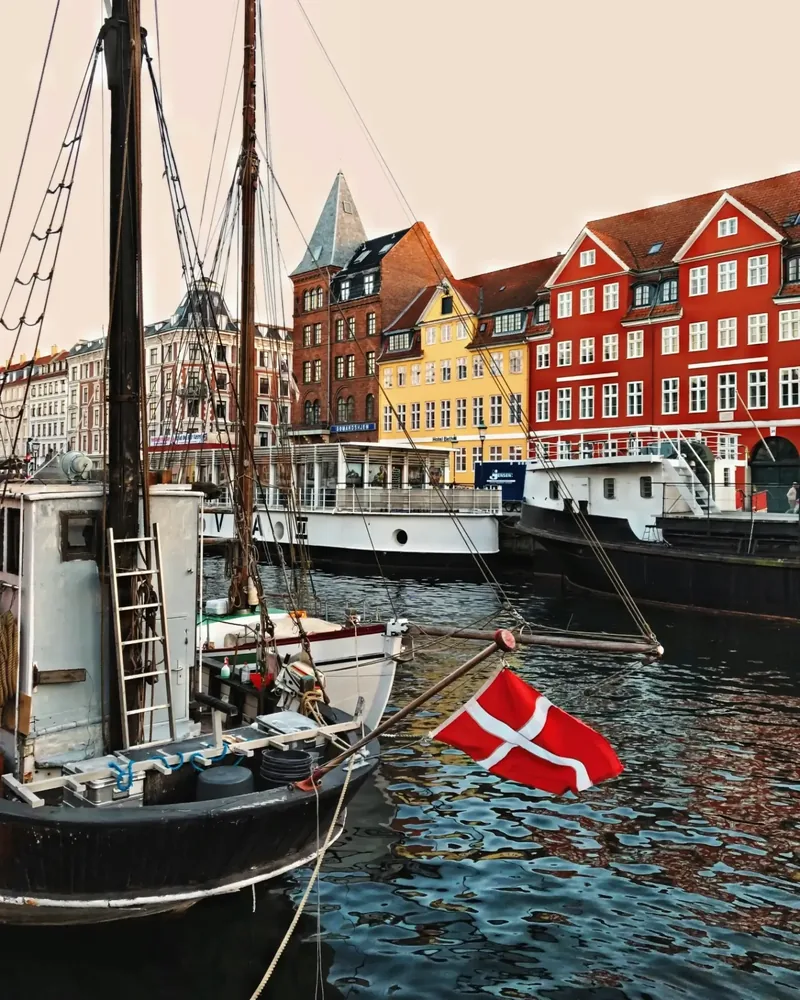
The Danish flag, called the Dannebrog, plays a part in many happy family occasions in Denmark. On birthdays, anniversaries and wedding days you will often see flags on poles in gardens, small paper flags on the table and tiny flags on top of a kransekage. For couples marrying in Copenhagen, a little Dannebrog in your photos is a light way to mark where it all happened.
Another custom is the æresport, an arch of honour made of green branches, often spruce, built around the front door of the couple's home or the venue. It is especially common for big wedding anniversaries, and it signals to the whole street that something is being celebrated.
Traditions that continue after the wedding
Danes mark the milestones of a marriage with real enthusiasm. The silver wedding, sølvbryllup, after 25 years and the golden wedding, guldbryllup, after 50 are often celebrated with an arch of honour, flags and a morning visit from friends and neighbours. A lovely way to carry your Danish wedding forward is to plan a return trip for an anniversary, walk past the place where you said yes, and raise a glass with a slice of kransekage.
Rice is traditionally thrown over couples as they leave the church or town hall in many countries, including Denmark. At Copenhagen City Hall, however, confetti and rice are not allowed, so save any throwing for another location and check with us first. Bubbles or a round of applause on the steps make a good alternative.
Read our Copenhagen City Hall venue guide for more about what to bring and what to leave at the hotel.
Which Danish traditions work for a civil wedding in Copenhagen?
Almost all of them, as long as you place them in the right part of the day. The civil ceremony itself has a fixed structure led by the registrar, so the traditions belong to the portrait walk, the toast and the dinner afterwards.
| Tradition | Where it fits | Practical tip |
|---|---|---|
| Kissing on chairs and under the table | Dinner, with guests or just the two of you | Tell the restaurant in advance so staff join in. |
| Bridal waltz | After dinner, a courtyard or a quiet spot outdoors | Choose a waltz you both know, or take a lesson at home. |
| Cutting the groom's socks | Straight after the waltz | Bring a spare pair and blunt-tipped scissors. |
| Kransekage | Coffee after dinner | Order a small one for a small group. |
| Speeches and songs | Throughout the dinner | Appoint a toastmaster to keep time. |
| Little flags | Table, cake and photos | Use paper flags and keep them small and tasteful. |
| Throwing rice or confetti | Not at City Hall | Use bubbles or applause, and ask us about other places. |
Our guide to ways to celebrate after your ceremony in Copenhagen has more ideas, from canal tours to long dinners. If you are bringing family and friends, planning a small wedding with guests in Copenhagen explains how to organise the day for a group.
How to combine Danish traditions with your own
Many of our couples come from two different countries, and some from three. Adding a Danish custom does not mean replacing your own. It simply gives your celebration a link to the place where you married.
- List the traditions that matter most to each of you and your families.
- Choose one or two Danish customs that feel natural alongside them, such as the waltz or the kransekage.
- Decide where each tradition fits in the day, so nothing feels rushed.
- Explain the Danish customs to your guests briefly, so everyone can join in.
- Tell us and your photographer what you are planning, so we can prepare and capture it.
Same-sex couples, couples without guests and couples who prefer a quiet day can adapt every one of these traditions. A Danish wedding has room for everyone: Denmark created the world's first registered partnership in 1989, and same-sex marriage has been legal here since 2012. Read more in same-sex marriage in Denmark.
If you like the calm, natural side of Danish weddings, our article on Scandinavian wedding style shows how to bring it into your outfits, flowers and table.
Plan a Danish wedding with your own traditions
The legal part of your wedding is our everyday work: we prepare your documents, file the application with Familieretshuset and book the ceremony. The traditions, the cake and the dinner are where we help you make the day personal.
See what is included in each option on our packages and prices page, from Essential at €290 to Premium at €1,590, or contact our team with your nationalities and preferred dates. You receive a free personal document checklist within 24 hours.
Written by the Denmark Wedding team in Copenhagen. Published 8 September 2026. Questions? Ask us directly.