Key takeaways
- The ceremony at Copenhagen City Hall lasts about fifteen minutes and follows a set structure.
- You state your full names, listen to a short speech, and each answer yes to one question.
- Only a few lines are legally required: the confirmation, your two answers and the declaration.
- Rings are optional, and you can ask in advance about adding short personal vows.
- The ceremony can be held in English, Danish or German, so you understand every word.
What does the registrar say at a Copenhagen City Hall wedding?
Many couples ask us the same question in the weeks before their wedding: what will actually happen in the room, and what will we have to say? It is a fair question. You may be marrying in a country where you do not speak the language, in front of a registrar you have never met, with your family watching on a phone screen back home. Knowing the words in advance turns the unknown into something you can look forward to.
At Copenhagen City Hall the registrar follows a short, warm speech used by the City of Copenhagen. Below you will find the English version that registrars read for international couples, and the Danish original. The wording can vary slightly from one registrar to another, and some add a personal sentence or two, but the structure and the legal lines are the same every time.
We have marked the moments that matter. The lines in gold are the part the law requires. The small notes in the margin show where you answer, so you will never wonder whether it is your turn.
The ceremony words in English

Copenhagen City Hall · the ceremony in English
Dear A and dear B
Welcome to Copenhagen City Hall on this beautiful day, your wedding day.
My name is registrar, I am your registrar, and it is a pleasure that I am going to perform your ceremony.
I hope that your wedding day will be amazing and filled with a lot of happy and joyful memories.
Before we begin, I would like both of you to state your full names:
Please state your full name A
Please state your full name B
Prior to the marriage, I would like to remind you of the meaning and the importance of the vow which you are making to each other by this act.
Marriage comes with rights and obligations, and it is founded on a promise to live together in mutual love, help, care and tolerance in every situation in life.
Your decision to get married is a strong and beautiful testimony that you want each other and that you love each other, bringing in the best of two worlds. There is every reason to celebrate today, and every day for the rest of your marriage.
With your love you must create a life, be each other's best friend, accommodate each other and make room for each other, both as a couple and as individuals. I hope you cherish exactly what makes your relationship so special, that you have chosen to be here today, and I wish that your married life may always be meaningful and harmonious, filled with great adventures and lots of love.
You have contacted the Copenhagen City Hall for the purpose of entering a civil marriage, and your wish to marry will now be confirmed before the public authorities.
I now ask you A, do you take B to be your spouse?
In the same way I ask you B, do you take A to be your spouse?
As a symbol for your dedication to each other and as a bond for eternity, you can now exchange rings.
You have now declared your vows to marry, and I therefore proclaim that you are now legally married.
Congratulations!
Where the text says (A) and (B), the registrar uses your first names or full names. The names you state at the start must match the names on the documents Familieretshuset approved, so say them exactly as they appear in your passports.
Which parts of the ceremony are legally required?
A Danish civil wedding is legally simple. Under Danish marriage law the ceremony needs three things: both of you present at the same time, two witnesses, and a registrar who receives your consent. Everything else, the welcome, the speech about love and friendship, the rings, is there to make the moment feel like a wedding rather than an appointment.
- The confirmation: The registrar states that you came to the municipality to marry by civil ceremony, and that your wish will now be confirmed before the public authorities.
- Your two answers: Each of you is asked, in turn, whether you take the other as your spouse. A clear yes from both of you is the legal heart of the ceremony.
- The declaration: The registrar proclaims that you are now legally married. From this moment the marriage is valid, and it is recognised abroad in the same way as a marriage at home.
Your witnesses do not have to speak. They are there to see that you both said yes of your own free will, and they sign with the registrar afterwards. If you travel without guests, we can arrange two witnesses for you.
The original Danish ceremony text
If one of you has Danish roots, or you simply love the sound of the language, you can ask for the ceremony in Danish. Here is the original text the English version is based on. The thoughts are the same, though the Danish speech spends a little longer on the everyday work of marriage: patience, loyalty, learning to forgive and giving each other room to disagree.
Copenhagen City Hall · vielsen på dansk
Kære A og B. Kære gæster
Mit navn er vielsesforretter, og det er en fornøjelse for mig at få lov til at vie jer.
Jeg håber, at dagen i dag må blive helt fantastisk for jer og fyldt med en masse dejlige minder. Inden jeg foretager vielsen, vil jeg minde jer om betydningen og vigtigheden af det løfte, som I nu vil give hinanden.
Inden vi starter, skal jeg bede om jeres fulde navne.
Hvad er dit fulde navn A
Hvad er dit fulde navn B
Ægteskabet er jeres løfte om at leve sammen og om at hjælpe hinanden gennem alle livets glæder og udfordringer i både kærlighed, venskab og tolerance. Ægteskabet kræver også, at I tager ansvar for jer selv og hinanden, og at I viser tillid til hinanden.
For ægteskabet er muligvis det største og mest udfordrende eventyr, man som menneske kan begive sig ud i, og det har I valgt at gøre sammen. Jeres ægteskab er ikke gjort ved ceremonien her i dag. Det er noget, I selv skal arbejde videre med.
Med kærlighed, tålmodighed og loyalitet, ved at tale og lytte, hjælpe, støtte og tro på hinanden. Gennem ømhed og latter, og ved at lære at tilgive og sætte pris på hinandens forskelligheder, og sidst men ikke mindst ved at lære at fokusere på det, der virkelig er vigtigt, og give slip på resten.
Husk, at ægteskabet ikke er det samme som at blive til ét menneske. I morgen, når I vågner, er I stadig to forskellige mennesker, sandsynligvis med forskellige meninger og holdninger. Giv hinanden plads til at være uenige og til at have egne drømme, ligesom I selvfølgelig også har jeres fælles drømme.
Jeg håber, at jeres ægteskab vil blive fyldt med mange gode grin og dejlige oplevelser.
I har henvendt jer til Københavns Kommune for at indgå ægteskab ved borgerlig vielse, og jeres ønske om ægteskab skal nu bekræftes.
Jeg spørger nu dig A, om du vil have B til ægtefælle?
På samme måde spørger jeg dig B, om du vil have A til ægtefælle?
Som symbol på jeres løfte til hinanden kan I nu udveksle ringe.
Efter I nu har bekræftet at ville ægte hinanden, erklærer jeg jer hermed at være ægtefolk.
Tillykke!
In Danish you answer with a single word: ja. Many couples who marry in English still love to say it, and registrars are happy to hear it.
How the ceremony runs, minute by minute
The ceremony itself is short, so it helps to know the rhythm of the day around it. A typical City Hall wedding looks like this:
- Before the ceremony: You check in at the wedding office with your passports. Your witnesses and guests take their seats, and the photographer finds a quiet corner.
- The welcome: The registrar greets you and your guests and introduces themselves.
- Your names: Each of you states your full name. This is the only thing you need to say before the vows.
- The speech: A few minutes about what marriage means: love, help, care, tolerance and making room for each other.
- The vows: The confirmation, then the question to each of you in turn, and your yes.
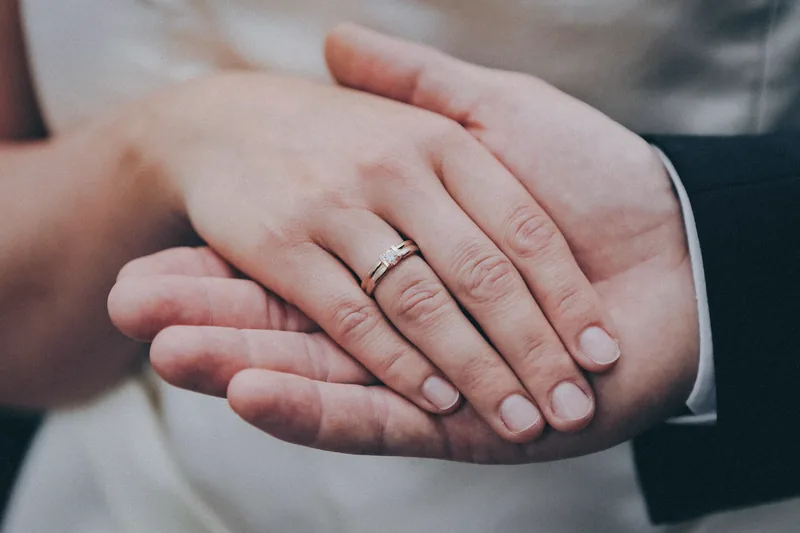
- The rings: If you have rings, this is the moment to exchange them. Then you may kiss.
- The declaration and signatures: The registrar declares you married, and you, your witnesses and the registrar sign. Your marriage certificate is handed to you.
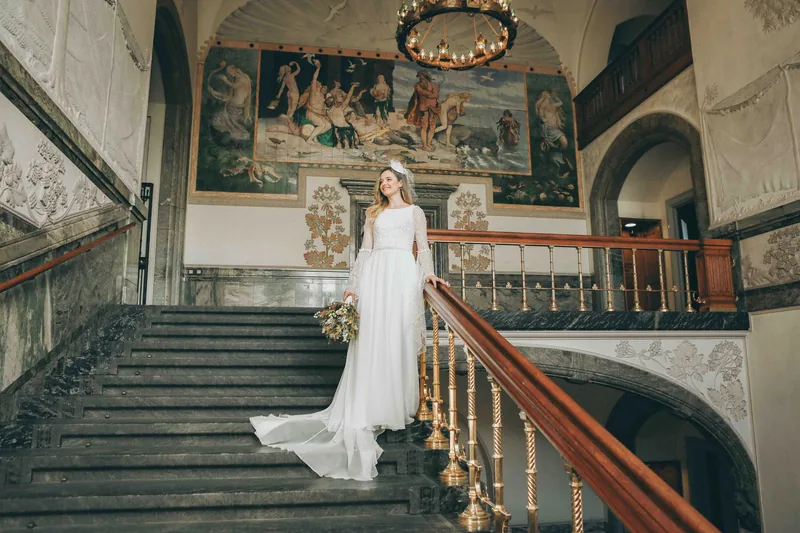
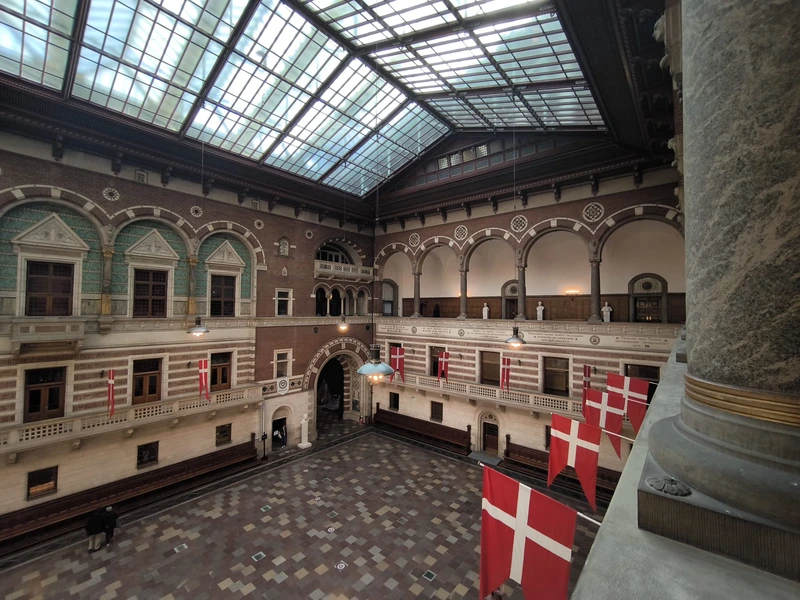
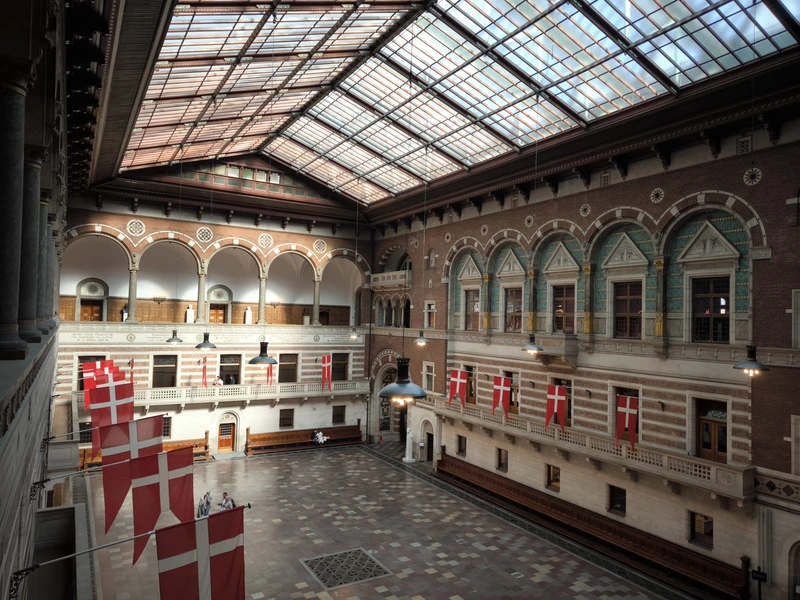
From the first word to the last it takes about fifteen minutes. Afterwards there is time for photos in the wedding hall and on the stairs, before you step out onto Rådhuspladsen as a married couple. Our guide to Copenhagen City Hall weddings covers booking, dates and guests in more detail. If you would like a photographer, our team’s first choice is Sla Karvounis Photography.
Can you add personal vows, readings or music?
The municipal speech is the frame, but it is not a cage. Couples often ask whether they can make the ceremony more personal, and in most cases they can, as long as it is agreed in advance and the ceremony keeps to its time slot.
- Personal vows: Short vows of a minute or two each can usually be added before the rings. Tell us in advance and we pass it on to the wedding office.
- Language: The ceremony can be held in English, Danish or German. You can also ask the registrar to say a sentence in your own language if you write it down for them.
- Rings: Optional. Some couples exchange rings, some wear rings they already own, and some have none at all. The marriage is just as valid.
- Music: City Hall weddings are short, so most couples play a song as they walk in or out, from a phone, rather than live music.
- Flowers: Bouquets and buttonholes are welcome. Confetti and rice are not allowed inside.
If you dream of a longer ceremony with readings, music and your own words from start to finish, an open-air wedding or a private registrar may suit you better. We can talk you through the options when you check your date.
How to feel calm and ready on the day
Most nerves come from not knowing what will happen. Now that you have read the words, there is very little left to fear. A few small things help on the day:
- Read the speech together the evening before, out loud, so the words feel familiar.
- Practise your full names exactly as they are written in your passports, including middle names.
- Decide who holds the rings: a witness, a guest, or one of you in a pocket.
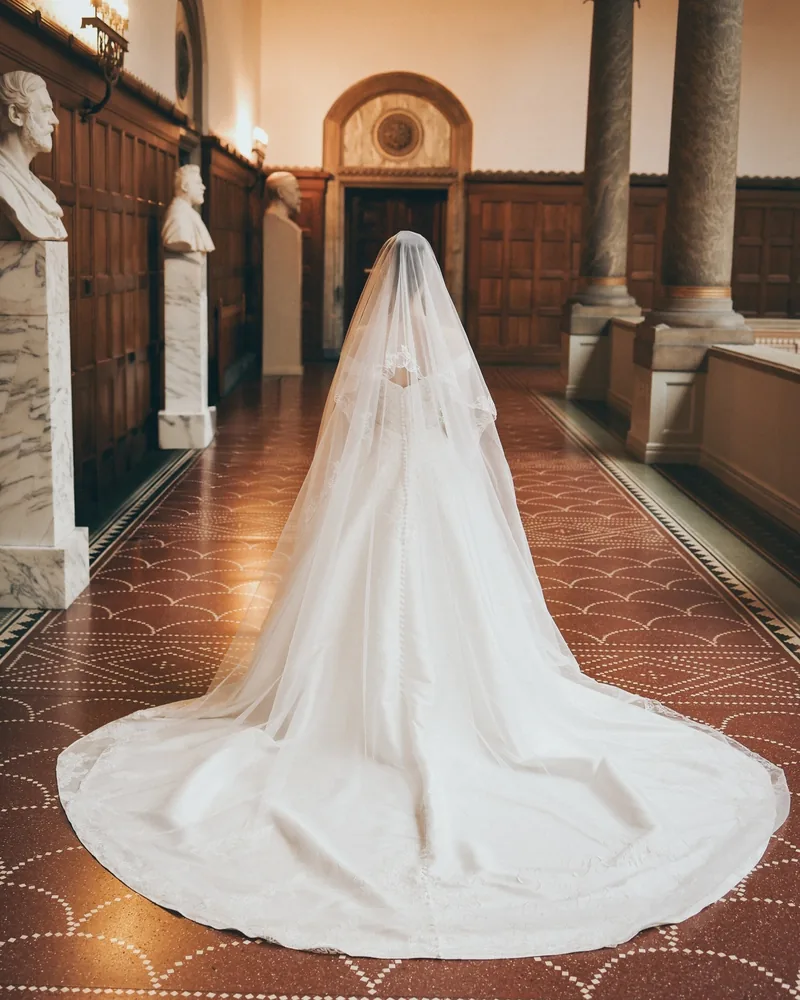
- Ask a guest to film from the side, so your faces are visible rather than the backs of your heads.
- Arrive at least fifteen minutes early, with your passports in a bag that is not in the car.
Then simply listen. The speech is short, and couples tell us that the line about making room for each other, both as a couple and as individuals, stays with them long after the day. If you would like the same words at home, many couples print them and frame them next to their marriage certificate.
What happens after you say yes?
The moment the registrar declares you married, you are legally married in Denmark. You sign, your witnesses sign, and you receive your Danish marriage certificate, a multilingual document that many countries accept as it is. Depending on where you live, you may need an apostille before you register the marriage at home, and we help with that too.
Then the celebration starts. Many couples walk from City Hall to Nyhavn for a toast by the water, or head straight to the best photo spots in Copenhagen while the light is soft. However you spend the rest of the day, you will remember the fifteen minutes in the wedding hall, and now you know every word of them.
If you are ready to hear these words for yourselves, see our packages and prices or send us your preferred date. We reply within one business day.
Written by the Denmark Wedding team in Copenhagen. Published 7 November 2026. Questions? Ask us directly.