Key takeaways
- Never book non-refundable flights before Familieretshuset has approved your application.
- Most delays come from documents that are incomplete, expired or spelt differently across papers.
- You must be lawfully present in Denmark on your wedding day, through a visa-free stay, a Schengen visa or a residence permit.
- Two witnesses are required at every ceremony, and we can provide them.
- The €282 AFL fee is included in Complete, Priority and Premium, but paid separately with Essential.
- Plan the apostille and home registration before the wedding, not after.
Why do small mistakes marrying in Denmark cause big delays?
Most mistakes marrying in Denmark are small, but they matter because the process runs in a fixed order. Familieretshuset, the Danish Agency of Family Law, must approve your application before the wedding office can confirm a date. If one document is missing or unclear, the file pauses until it is corrected, and every step behind it waits.
The positive side is that Denmark is efficient when the file is clean. Approval can come in as little as five business days, and most of our couples are married 4 to 8 weeks after first contacting us. An express date is possible only when a private registrar is available. Avoiding the mistakes below is what keeps you on track.
| Mistake | What it causes | The simple fix |
|---|---|---|
| 1. Booking flights before approval | Rebooking costs and stress | Book flexible fares or wait for approval |
| 2. Leaving too little time | No margin for a correction | Allow 4 to 8 weeks after first contacting us |
| 3. Unchecked documents | Paused application | Pre-check every page before submission |
| 4. Ignoring visa rules | No lawful stay on the day | Check entry rules early |
| 5. Names that do not match | Questions from the authority | Compare spellings across all papers |
| 6. No witnesses arranged | No ceremony | Bring two or ask us to provide them |
| 7. Arriving late at City Hall | A rushed or missed slot | Arrive 10 to 15 minutes early |
| 8. Underestimating costs | Budget surprises | Count the €282 AFL fee from the start |
| 9. Forgetting the apostille | Delays registering at home | Plan legalisation before the trip |
| 10. No plan B | Weather or timing stress | Keep an indoor option and a free hour |
Mistakes 1 and 2: booking flights too early and leaving too little time
The single most expensive mistake is booking non-refundable flights and hotels before your application is approved. Couples understandably want to lock in prices, but the ceremony date cannot be confirmed until Familieretshuset has said yes. If anything needs correcting, the date moves and the tickets do not.
The second mistake is the opposite side of the same coin: leaving too little time. A plan that only works if every document is perfect on the first attempt leaves no room for an apostille that takes longer than expected, or a certificate that needs to be reissued at home.
- Choose flexible or changeable fares if you must book early.
- Allow 4 to 8 weeks between first contacting us and your preferred date, and ask early for popular summer Saturdays.
- Arrive at least one day before the ceremony, not on the morning itself.
- Avoid planning your wedding on the last day of a visa or a fixed holiday.
Mistake 3: sending documents that are incomplete or unchecked
Incomplete or unchecked documents are the most common reason an application slows down. Every couple needs valid passports, but the other papers depend on nationality, previous marriages and where you live.
Typical problems we catch in pre-checks include an expired passport, a divorce certificate without the final decree, a missing translation, a page that was not scanned, or a document from the wrong authority. None of these is dramatic, but each can pause the file.
- Request your free personal document checklist, which arrives within 24 hours.
- Gather every document on the list, including previous marriage and divorce papers.
- Check validity dates and whether any document needs an apostille or translation.
- Send clear, complete scans of every page for our pre-check.
- Correct anything we flag before the application goes to Familieretshuset.
Our guide to the documents needed to marry in Denmark explains what usually applies. If either of you has been married before, read our article on marrying in Denmark after a divorce, because those papers need extra care. Your personal checklist always confirms the exact requirements for your situation.
Mistake 4: overlooking visa and entry rules
You must be lawfully present in Denmark to marry there. That can mean a visa-free stay, a Schengen visa or a residence permit, depending on your passport. Couples sometimes assume the marriage application covers entry too, but the two are separate.
If you need a Schengen visa, the visa application has its own timing and requirements, and your marriage approval does not guarantee that a visa is granted. Plan both in parallel and make sure the visa covers your arrival, your ceremony date and a little margin either side.
Denmark does not require a period of residence before marrying, so a short stay is fine as long as it is lawful. Read our guide on the visa to get married in Denmark for the general picture, and check official entry information at New to Denmark.
Mistake 5: names and details that do not match
Names that are spelt differently on different documents cause more questions than almost anything else. A missing middle name on a divorce decree, an accent dropped in a passport, or a surname written in two ways after a transliteration can all make an authority ask for clarification.
This is especially common for couples whose documents come from countries with different alphabets, or where one partner changed their name after an earlier marriage. It does not usually stop the process, but it can add a round of explanation.
- Compare your full name, character by character, on every document.
- Check dates and places of birth for consistency.
- Note any name change and keep the document that proves it.
- Tell us early about any known difference, so we can explain it in the application.
Mistakes 6 and 7: forgetting witnesses and arriving late
Two witnesses must attend every civil ceremony in Denmark. Couples who travel alone sometimes discover this late. If you are eloping, simply tell us, and we arrange two witnesses who meet you before the ceremony. If friends are coming, check that they bring valid photo identification.
Late arrival is the other easy mistake. Copenhagen City Hall is a large building, and ceremonies follow each other closely. Arriving 10 to 15 minutes before your time, as the city asks, gives you time to follow the hearts on the floor to the waiting area, gather your guests and breathe before you walk in.
What to bring on the day
- Both passports, the same ones used in your application.
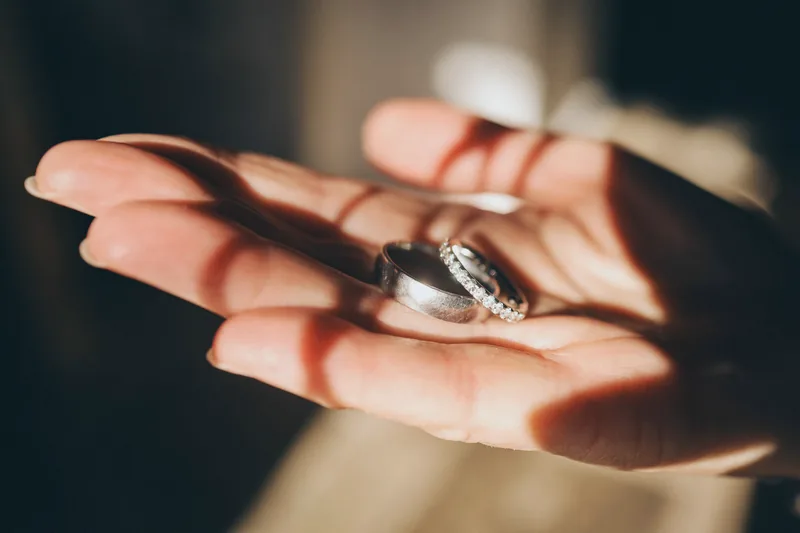
- Your rings, if you plan to exchange them, kept by one person only.
- Your two witnesses if you bring your own (they need no ID), or rely on the two official witnesses the city provides.
- A folder to keep the marriage certificate flat afterwards.
- Flowers if you like; confetti and rice are not allowed inside City Hall.
A short printed timetable with addresses and phone numbers helps too, especially if guests are meeting you there. Phones run out of battery on busy days, and paper never does.
Our guide to wedding witnesses in Denmark explains who can act as one, and the City Hall venue page shows how a typical morning runs.
Mistake 8: underestimating what the wedding really costs
Couples often compare package prices without noticing what is included. The Familieretshuset (AFL) fee of €282 is a mandatory government charge for every application. It is included in our Complete, Priority and Premium packages, but with Essential you pay it yourself, on top of the €290 package price.
| Package | Package price | AFL fee | Total for the legal part |
|---|---|---|---|
| Essential | €290 | €282 paid separately | €572 |
| Complete | €690 | Included | €690 |
| Priority | €1,190 | Included | €1,190 |
| Premium | €1,590 | Included | €1,590 |
All our prices include tax and 25% Danish VAT, with no hidden fees. Travel, accommodation, apostilles in your home country, translations, outfits, flowers and any dinner come on top, so build those into your budget early.
Our Denmark wedding cost guide breaks down a full budget, and our article on choosing a Denmark wedding package helps you decide which level of support is worth it for you. You can also compare the details on the packages page.
Mistake 9: forgetting the apostille and registration at home
Many couples focus so hard on the wedding that they forget what happens next. Your Danish marriage certificate is valid from the moment you sign, but your home country may need it apostilled, sometimes translated, and registered before it updates your records.
Danish apostilles are issued by the Danish Ministry of Foreign Affairs. Countries such as India, China, the Philippines, the United States, the United Kingdom and Australia are all parties to the Apostille Convention, which makes the process straightforward for them. Other countries may need a different legalisation route.
Plan this before you travel. Ask which language version of the certificate you need and whether your country requires registration within a set period. Our guide to the apostille for a Danish marriage certificate and our article on the next steps after your wedding cover both.

Mistake 10: planning the day with no room for weather or nerves
The last mistake is planning the wedding day too tightly. A ceremony at 11:00, portraits at 11:30, a canal boat at 12:15 and a train at 14:00 looks efficient on paper, but leaves no room for a shower of rain, a slow taxi or simply wanting to stay on the square a little longer.
Outdoor ceremonies need a plan B in particular. The open-air ceremonies offered by the Copenhagen wedding office are beautiful, but Danish weather changes fast, so we always agree an indoor option in advance. Our article on outdoor weddings in Copenhagen explains how that works.
- Keep at least one unplanned hour after the ceremony.
- Pack a light jacket or wrap, even in summer.
- Bring flat shoes for cobbles and change for photos.
- Carry your outfit in the cabin when you fly; our guide on travelling with a wedding dress has tips.
How can you avoid these mistakes from the start?
The surest way to avoid these mistakes is to start with an accurate, personal checklist and have every document checked before it reaches the authority. That is exactly how we work: you tell us your nationalities and dates, and within 24 hours you receive your checklist.
Our consultants then pre-check everything, file the application under power of attorney if your package includes it, track approval and book your ceremony. You can see the whole route on our how it works page, and general information about the authority is available from Familieretshuset.
When you are ready, contact our team to check your date, or compare the packages to choose the support that fits your plans.
Written by the Denmark Wedding team in Copenhagen. Published 9 August 2026. Questions? Ask us directly.