

Key takeaways
- Chinese citizens can marry in Denmark without living there, provided they are lawfully present on the wedding day.
- Most mainland Chinese passport holders need a Schengen visa, unless they hold a Schengen residence permit.
- China has been a party to the Apostille Convention since November 2023, which replaced the older chain of consular legalisation for many documents.
- A signed declaration in the application covers your marital status, and translations of any divorce or other Chinese documents must match the pinyin spelling in your passports.
- The Danish ceremony is held in English, Danish or German, so couples who prefer Chinese should plan interpretation early.
Can a Chinese couple marry in Denmark?
Yes. A Chinese couple marriage in Denmark is a fully legal civil marriage, and neither partner needs Danish citizenship or residence. The same applies when one partner is Chinese and the other holds a different nationality, which is a very common situation among our couples.
Chinese couples choose Denmark for different reasons. Students and professionals living in Europe often want a straightforward legal wedding close to where they already are. Couples from China may combine the ceremony with a European honeymoon. Mixed couples value a neutral country with a clear process and ceremonies in English.
This guide explains the general process for Chinese citizens from the mainland, with a short note on Hong Kong and Macau. Rules change and cases differ, so please treat it as an overview. Your free personal document checklist is what confirms the exact requirements for you.
Do Chinese citizens need a visa to marry in Denmark?
Most do. Holders of mainland Chinese passports generally need a Schengen visa for a short stay in Denmark, unless they already hold a residence permit or long-stay visa from a Schengen country that allows travel. Danish law requires that you are lawfully present on your wedding day.
The visa and the marriage application are separate processes handled by different authorities. We help you plan the order sensibly, so the approval and the visa line up with your travel dates.
- Couples living in mainland China usually apply for a short-stay Schengen visa for Denmark.
- Couples studying or working in a Schengen country often travel on their residence permit.
- Couples living in the UK, North America or elsewhere follow the visa rules for where they apply.
- Holders of Hong Kong or Macau SAR passports usually have different, often visa-free, travel rules.
The Danish immigration service publishes guidance at nyidanmark.dk, and the Danish Ministry of Foreign Affairs at um.dk. Our article on the visa to get married in Denmark explains the general picture.
Which documents do Chinese citizens usually need?
Usually valid passports and proof of lawful stay in Denmark. If either of you was married before, a divorce certificate, divorce judgment or the death certificate of a former spouse is added, and if you have children together, their birth certificates are included too.
Mainland Chinese citizens need no notarial papers about their marital status. You each sign a truthful declaration in the Familieretshuset application, and that signed declaration is enough. Chinese documents only come into the file where your situation calls for them, such as a divorce certificate or court judgment, and your checklist names exactly what is expected, including any notarisation or apostille.
| Situation | Documents that often come up |
|---|---|
| Never married | Passport and proof of lawful stay |
| Divorced | As above, plus the divorce certificate or court judgment |
| Widowed | As above, plus the death certificate of the former spouse |
| Children together | As above, plus the birth certificates of your children |
| Living outside China | As above, plus the residence permit you travel on |
Our general guide to the documents needed to marry in Denmark explains how the pieces fit together. Every scan is pre-checked by our team before filing, so problems are solved early. Notarial certificates can have a limited validity period, so try not to order them too far ahead of filing.

How has the Apostille Convention changed things for China?
It has made certification simpler. China joined the Apostille Convention with effect from November 2023. Before that, Chinese documents for use in Denmark typically went through a chain of legalisation, ending at the Danish embassy or a consulate. Now many public documents can be certified with a single apostille.
In mainland China, apostilles are issued by the Ministry of Foreign Affairs and by local foreign affairs offices it has authorised. Hong Kong and Macau have their own apostille authorities and had apostilles long before 2023. Which office applies depends on where your document was issued.
| Before November 2023 | Since November 2023 | |
|---|---|---|
| Typical route | Notarisation, then foreign affairs office, then the Danish mission | Notarisation where needed, then one apostille |
| Number of steps | Several, at different offices | Usually fewer |
| Who confirms requirements | Your personal checklist | Your personal checklist |
Whether a specific document needs an apostille for Familieretshuset is something we confirm in your checklist. When you go home, your Danish certificate can be apostilled by the Danish Ministry of Foreign Affairs. Our guide to the apostille for a Danish marriage certificate covers that step.
How should names and translations be handled?
Every translation must match your passports exactly. Chinese documents use characters, while passports show names in pinyin, so a translation that spells a name differently, or swaps the order of family and given names, can lead to questions.
Notary offices in China often issue certificates with an attached English translation. If a separate translation is needed, your checklist says which language and form are accepted. We compare names, dates of birth and passport numbers across every page before filing.
- Use the exact pinyin spelling from your passport in every translation and form.
- Keep the family name and given name in the same order on every document.
- Check that dates of birth are written consistently, as date formats differ.
- Keep documents that explain any former names or changes in household registration.
What is the ceremony like, and which language is used?
The ceremony is a short civil wedding led by a registrar, held in English, Danish or German. You both answer the legal question, exchange rings if you wish and sign the register with your two witnesses, and you receive your certificate on the day.
The registrar must be sure you both understand what you are agreeing to. If either of you is not comfortable in English, tell us when you first contact us, so we can discuss interpretation with the wedding office well in advance. Two witnesses are required, and we can arrange them if you travel without guests.
Most ceremonies take place at Copenhagen City Hall, with its granite staircases and painted ceilings. On selected days you can also marry at an open-air location, with exactly the same legal effect.

Can we add Chinese wedding traditions?
Yes. The Danish civil ceremony is the legal marriage, and you are free to celebrate in your own way around it. Some couples hold a tea ceremony with parents at home before or after the trip. Others plan a family banquet in China months later and keep the Danish day small and personal.
Red is warmly welcome at a Danish wedding. A qipao, a red bouquet or red details in your outfits look beautiful against the white stone and dark wood of the wedding hall. Many brides wear a white dress for the ceremony and change into red for dinner.
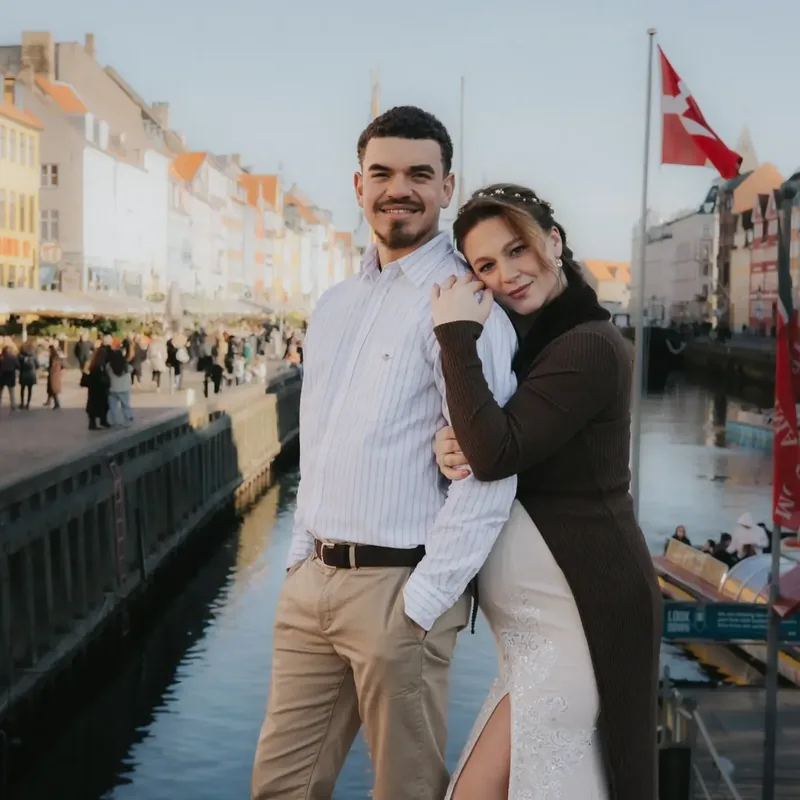
For portraits, the colourful facades of Nyhavn, the gardens of Rosenborg and the Little Mermaid are all close by. Our wedding inspiration page shows the feel of a Copenhagen wedding, and our services page explains how we help with photographers and dinners. For your photos, our team’s favourite is Sla Karvounis Photography.
How long does it take?
Allow more time than the Danish approval itself. Familieretshuset can approve a complete file in as little as five business days, but a Schengen visa, and any notarisation and apostilles, usually take longer, so start as soon as you have a travel window.
- Send us your nationalities and preferred months; your free checklist arrives within 24 hours.
- Obtain any notarised documents and apostilles your checklist names, in China or wherever they were issued.
- Send scans for our pre-check, including every translation page.
- We file with Familieretshuset, or guide you to file yourselves with Essential.
- Plan the visa appointment in step with the approval.
- We book your ceremony at the first suitable slot, and you travel to Denmark.
Our article on how long it takes to get married in Denmark gives more detail. We never promise timings on behalf of the authorities, but a complete file is always the fastest route.
Planning the trip from China
Copenhagen is six or seven hours behind Beijing, depending on the season, and the journey is long, so give yourselves at least two nights before the ceremony. Use the first day to rest and walk along the canals, and the second for a hair trial or a meeting with your photographer.
Pack outfits, rings and original documents in your hand luggage, together with printed copies of the approval and your bookings. Many couples then continue to Malmö across the Øresund Bridge, to Kronborg in Helsingør or to the island of Ærø for a few quiet days. Our honeymoon ideas for Denmark offer more inspiration.
Is a Danish marriage recognised in China?
A Danish civil marriage is a legally binding marriage, and the certificate can be apostilled for use abroad. China generally treats a marriage concluded abroad according to local law as valid, but how you register or use it at home depends on your circumstances, so check with the relevant Chinese authority or a lawyer.
In practice, couples use the certificate for spouse visas, residence permits and records in the country where they live. Each authority sets its own rules for apostilles and translations. Danish certificates can be issued in English, which most offices find easier to work with.
Same-sex marriage has been legal in Denmark since 2012, and every couple is welcome. Mainland China does not currently recognise same-sex marriage, so same-sex couples should seek advice about how the marriage will be treated at home. Our guide to whether a Danish marriage is recognised abroad explains the general principles.
What does it cost, and how do we start?
Our packages cost €290, €690, €1,190 and €1,590, all including tax and 25% Danish VAT. The €282 Familieretshuset (AFL) fee is included in Complete, Priority and Premium; with Essential you pay it to the authority yourself.
| Package | Price | Often chosen by |
|---|---|---|
| Essential | €290 | couples in Europe who are confident with the paperwork |
| Complete | €690 | couples who want us to process the application |
| Priority | €1,190 | couples with a fixed visa window; express date when a private registrar is available |
| Premium | €1,590 | couples who want photography, hair and makeup arranged |
Any notary fees, apostilles, visas, flights and hotels come on top. See every inclusion on our packages page. When you are ready, contact our consultants with your nationalities, where your documents were issued and your preferred months, and we reply within one business day with your checklist and realistic dates.
Written by the Denmark Wedding team in Copenhagen. Published 22 July 2026. Questions? Ask us directly.